 Jiangsu Shendian Electric Co., Ltd.
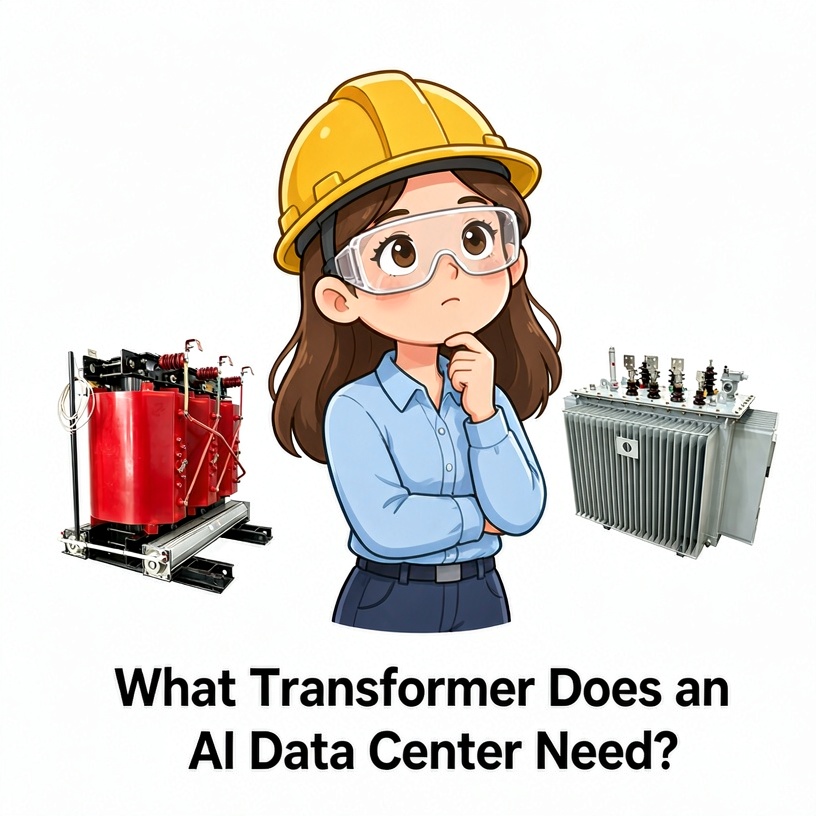
An AI data center is no longer a building full of servers — it is a power plant with racks inside. A single GPU cabinet that drew 8 kW five years ago now draws 60 to 120 kW, and the electrical room has become the part of the project most likely to delay energization. According to the International Energy Agency, global data center electricity consumption is expected to reach around 950 TWh by 2030 — roughly double the 2025 level — with AI-driven facilities growing fastest.
That makes one question unavoidable for every developer, EPC contractor and procurement team: what transformer does an AI data center actually need? Not which catalog item to tick, but which combination of capacity, voltage, technology and redundancy will keep a 100 MW campus online for a decade. This guide answers that question in the order the decisions are actually made.
1. Where Does the Transformer Sit in an AI Data Center Power Path?
A modern AI facility uses several transformers, each doing a different job. Reading them as one product category is the most common source of specification errors, because a 200 MVA grid transformer and a 2,500 kVA cast-resin unit have almost nothing in common technically or commercially.
A typical power path runs: high-voltage grid → main substation transformer → medium-voltage distribution → unit substation or distribution transformer → low-voltage switchgear → UPS → PDU → rack. At each step the transformer changes one variable — voltage — while the requirements for losses, impedance and fire safety change with it.
Table 1. Transformer roles in an AI data center and what drives each selection
| Role in the power path | Typical voltage | Typical capacity | Usual technology | What decides the choice |
|---|---|---|---|---|
| Main substation (grid connection) transformer | 110–220 kV → 33 / 13.8 kV | 40–200 MVA | Oil-immersed, ONAN/ONAF, OLTC | Short-circuit withstand, impedance, no-load loss; usually specified by the utility |
| Unit substation transformer (MV room, feeds LV switchboard) | 33 / 13.8 / 11 kV → 415 / 400 V | 1,000–3,500 kVA | Cast-resin dry type, or oil-immersed | Fire rating, footprint, indoor clearance, impedance for downstream breakers |
| Distribution transformer (campus, outdoor) | 33 / 13.8 kV → 415 V | 500–2,500 kVA | Pad-mounted oil-immersed | Enclosure rating, ambient temperature, corrosion, access for maintenance |
| Auxiliary / isolation transformer (UPS bypass, controls) | LV / LV | 50–1,000 kVA | Dry type, K-factor rated | Harmonic loading from switch-mode power supplies, voltage regulation |
| Rectifier / DC-bus transformer (emerging 800 VDC architecture) | MV → 800 VDC via rectifier | Project specific | Dry type or oil-immersed | Harmonic spectrum, DC ripple, coordination with rectifier vendor |
The practical takeaway: before asking any supplier for a price, map your single-line diagram against this table. Most quotations that arrive “wrong” are simply quoted against the wrong role in the chain.
2. How Much Capacity Does an AI Data Center Transformer Need?
Size the transformer on total facility load, not IT load. In an AI hall the non-IT share is unusually large and unusually variable: liquid cooling loops, chillers and pumps, UPS and conversion losses, battery charging, networking, lighting and building services all sit behind the same transformer.
Three rules keep capacity decisions defensible:
- Design for the rack density you will run in year three, not the density you commissioned with. AI halls are routinely re-racked at two to three times the original power per cabinet.
- Split large loads across multiple units. A single 20 MVA unit saves space but concentrates risk; four to six smaller units give you redundancy, spares commonality and staged energization as halls come online.
- Carry explicit spare capacity for cooling. A hall designed at 30 MW of IT load commonly draws 38 to 42 MW at the meter once cooling and losses are counted — and liquid cooling moves that number, not reduces it.
Hyperscale AI campuses now exceed 100 MW of connected load, and the industry expectation is that 1 GW campuses will be discussed within this decade. At that scale the transformer fleet — not the individual transformer — becomes the design object, and standardizing on two or three ratings matters more than optimizing any single unit.
3. Which Voltage Levels Should the Design Use?
Voltage is decided by the utility first and the distribution architecture second. The common patterns are:
- 33 kV or 13.8 kV medium-voltage distribution inside the campus, stepped down to 415/400 V at the unit substation.
- 11 kV or 10 kV where the local grid requires it, common in Southeast Asia and parts of Europe.
- 480 V or 600 V low-voltage distribution in North American designs.
- 800 VDC at the rack level — the direction the Open Compute Project is pushing for next-generation AI infrastructure, which changes what the upstream rectifier transformer must handle.
Holding a higher distribution voltage across longer distances reduces current and resistive loss; the U.S. Department of Energy makes the same point in its guidance on energy-efficient data center design. On a large campus, moving the step-down point closer to the hall is often worth more in annual losses than upgrading the transformer efficiency class — but only if the MV cabling and switchgear cost is counted honestly.
4. Dry Type or Oil-Immersed: Which Fits an AI Data Center?
Both technologies are used in AI facilities, and the choice is driven by location and fire strategy far more than by price. Inside a building, the deciding documents are the fire code and the insurer’s requirements; outdoors, they are ambient temperature, enclosure rating and access.
Table 2. Dry-type versus oil-immersed transformers for data center applications
| Criterion | Dry type (cast resin / VPI) | Oil-immersed |
|---|---|---|
| Typical installation | Indoor electrical rooms, data hall mezzanines, urban and high-rise sites | Outdoor substation yards, pad-mounted units, campus distribution |
| Fire behaviour | Self-extinguishing; F1 fire class available; no oil pool or bunding required | Mineral oil is combustible; needs oil pit, fire wall and separation distances |
| Practical capacity range | Up to roughly 10 MVA, typically ≤ 35 kV | From a few hundred kVA to 200 MVA and above |
| Efficiency at equal rating | Higher no-load loss; efficiency gap widens with size | Lower total loss at large ratings; better lifecycle cost above ~5 MVA |
| Footprint and clearances | Smaller clearances, no oil containment, easier indoor routing | Larger footprint once bunding and fire separation are counted |
| Environmental sensitivity | Needs clean, ventilated rooms; humidity and dust control matter | Tolerant of outdoor heat, dust and pollution with proper IP enclosure and corrosion coating |
| Maintenance routine | Visual inspection, cleaning, partial discharge monitoring | Oil testing, DGA, breather and gasket checks |
| Cost profile | Higher first cost per kVA at large ratings | Lower first cost at large ratings; adds civil works for oil containment |
| Best fit in an AI campus | Unit substations inside halls, UPS rooms, retrofit and modular builds | Main substation, campus distribution, high-capacity outdoor blocks |
A workable default for most AI campuses: oil-immersed at the main substation and for outdoor campus distribution, cast-resin dry type for every unit substation inside the building line. Where the local fire authority is strict, or the site is a multi-tenant colocation with tenants carrying their own insurance, dry type inside the building is usually non-negotiable.
5. Which Specifications Actually Matter for AI Loads?
Rated kVA is the least interesting number on the datasheet. For AI facilities, five parameters decide whether the transformer performs for fifteen years:
Impedance
Impedance sets the downstream fault level. Too low and the LV switchgear and busway must be rated higher; too high and voltage regulation suffers under the step loads typical of GPU clusters. Fix impedance before asking for quotes, and require the supplier to state the tolerance.
Losses evaluated over the real load profile
AI halls run near full load around the clock, so load loss dominates lifecycle cost — the opposite of a residential distribution duty cycle where no-load loss matters more. Ask for both figures at reference temperature and calculate cost of ownership at your actual utilization, not at 50% load.
Harmonic and non-linear load capability
Switch-mode power supplies, UPS rectifiers and variable-frequency drives inject harmonics. Specify K-factor rating or a derating basis, plus a temperature rise that already accounts for harmonic loss, rather than discovering the problem in the first summer.
Thermal design for the actual ambient
A transformer rated at 40 °C ambient is not the same product in a 50 °C Gulf summer inside a metal enclosure. State the ambient, the enclosure type and the required temperature rise together, and let the supplier prove the derating in writing.
Short-circuit and seismic withstand
Both are type-test subjects, not design intentions. Ask for third-party type-test reports — short-circuit, temperature rise and dielectric — from a laboratory accredited to ISO/IEC 17025, and check that the tested rating actually brackets what you are buying.
6. How Much Redundancy Do You Need?
Redundancy is a cost decision disguised as a reliability decision. The common arrangements are N+1 (one spare unit in a group), 2N (two fully independent paths), and distributed or block redundancy, where smaller transformers are cross-connected so any single failure sheds only part of the hall.
For AI halls, N+1 per electrical block is the usual baseline; 2N is justified where tenant SLAs or contractual penalties demand it, or where maintenance cannot be scheduled without load shedding. What matters technically is that redundancy is designed at the transformer level and carried through switchgear, busway and UPS — redundancy that stops at the transformer is decoration.
7. What Does a Practical Selection Process Look Like?
A sequence that survives review, project after project:
- Total the facility load — IT, cooling, UPS losses, auxiliaries — and add explicit growth.
- Confirm the utility connection point and voltage; get the short-circuit level from the utility in writing.
- Fix the distribution architecture, including whether DC distribution is in scope.
- Split capacity into units and set the redundancy scheme.
- Choose technology by location and fire strategy, not by habit.
- Set impedance, losses, harmonic capability and temperature rise against the real load profile and ambient.
- Confirm standards and testing: IEC 60076 for transformers, IEC 62271-202 for prefabricated substations, IEEE C57 where the project is US-based — and require type-test reports from an accredited laboratory.
8. How Can SHENDIAN Electric Support an AI Data Center Project?
SHENDIAN Electric has manufactured oil-immersed and dry-type transformers since 2007 in a 30,000 m² facility in Jiangsu, China, with 138 employees and a product range covering 10 kV to 35 kV distribution transformers, cast-resin dry types, pad-mounted units and prefabricated substations. One of our amorphous-alloy models, the 2,500 kVA SH15/SBH15 series, has passed the national short-circuit type test.
For data center projects we typically work from the load list and single-line diagram rather than a catalog page: we confirm impedance and losses against your fault level, quote 50 Hz or 60 Hz designs, match enclosure and corrosion class to the site, and support the type-test file your consultant or insurer will ask for. Standard ratings ship in about four weeks; non-standard and prefabricated substation packages are quoted case by case.
If you are specifying transformers for an AI data center, send us the capacity, voltage levels, ambient conditions and applicable standard — we will come back with a configuration and an indicative price, not a brochure.
WeChat
Scan the QR Code with wechat