 Jiangsu Shendian Electric Co., Ltd.
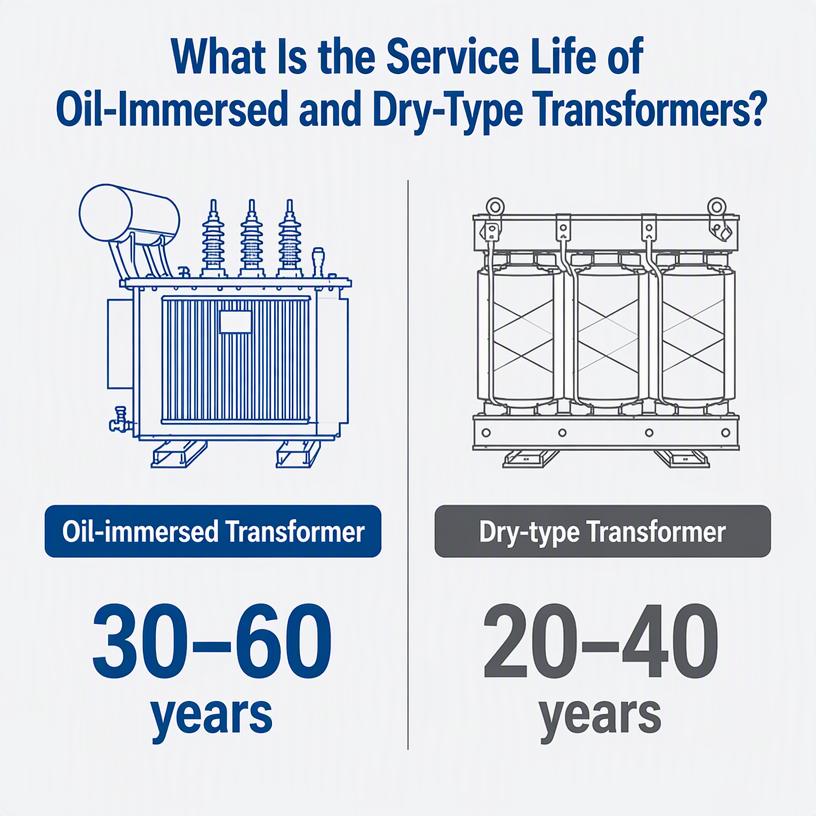
| In short: Oil-immersed transformers are designed for 30–40 years and, with good maintenance, often stay in service for 50–60 years. Dry-type transformers are designed for 20–30 years, but many are replaced far sooner. |
Transformer service life matters to anyone planning capital budgets, maintenance schedules, or facility upgrades. Unlike cables or switchgear that come with fixed replacement intervals, a transformer’s lifespan depends on how it was designed, where it is installed, and how it is operated. Knowing the realistic range for oil-immersed and dry-type units makes replacement easier to budget for and helps avoid unplanned outages.
Design Life vs. Actual Service Life
Large power transformers are built to last 30 to 40 years. That figure is a design target under controlled conditions, not a guarantee. In the field, well-maintained oil-immersed transformers regularly reach 50 years, and some run past 60. Their simple construction and rugged mechanical design are the main reasons they hold up so well.
Dry-type transformers have a shorter design life, usually 20 to 30 years, although some manufacturers claim more than 30 years for sealed cast-resin units. Field data is harsher: an IEEE study put the useful life of dry-type transformers at just 12 to 15 years, and found that most units were replaced after only 5 to 10 years because they were not monitored closely enough. In other words, how a transformer is maintained often matters more than the number on its nameplate.
At a Glance: Oil-Immersed vs. Dry-Type
| Parameter | Oil-Immersed Transformer | Dry-Type Transformer |
| Design life | 30–40 years | 20–30 years |
| Practical maximum | 50–60 years with maintenance | 30–40 years (sealed units) |
| Typical life (station service) | 32–55 years (typical 45) | 20–40 years (typical 30) |
| Primary ageing factor | Paper insulation degradation (heat, moisture) | Insulation surface contamination, moisture |
| Maintenance requirement | Oil testing, reclamation, leak repair | Cleaning, moisture control |
Sources: IEEE studies, Ontario Energy Board asset data, and ABB technical papers.
What Determines Service Life?
Heat and moisture are the two biggest drivers. Working together, they break down the mineral oil and the cellulose paper insulation inside a transformer. The classic rule of thumb still holds: every 10°C increase in operating temperature can cut expected life in half, and moisture does similar damage. In hot climates with strong sunlight, winding hot spots can push past safe limits and age the insulation faster.
Dry-type transformers fail differently. With no oil to protect the windings, dirt and moisture become the main threat. Dust builds up on insulation surfaces, creating conductive paths and blocking airflow through the windings, which raises internal temperatures. In clean, dry conditions a dry-type transformer can last 50 to 60 years. In damp or dirty environments, that figure drops sharply.
Loading patterns matter as well. Reliability falls off quickly once loading climbs from 80% to 100% of rated capacity. Harmonics from non-linear loads add further heat stress, which is a particular concern for dry-type units feeding inverters or rectifiers.
How to Extend Transformer Service Life
A regular preventive maintenance program is the most effective way to get the longest service out of a transformer. The program should match the unit’s condition, its location, and the manufacturer’s recommendations.
- Oil-immersed units:Oil reclamation and moisture removal restore the insulating fluid and slow paper ageing. Online dehydration systems have been shown to extend insulation life by up to 7.4 times compared with offline methods.
- Dry-type units:Keeping the unit and its surroundings clean and dry, through periodic vacuum cleaning or dry-air purging, can add years of service.
In the end, service life is not a fixed number. It is a function of how a transformer is operated and maintained. Owners who run structured monitoring programs, such as dissolved gas analysis for oil-filled units and thermal imaging for dry-type units, consistently get longer life and fewer unplanned outages.
WeChat
Scan the QR Code with wechat