 Jiangsu Shendian Electric Co., Ltd.
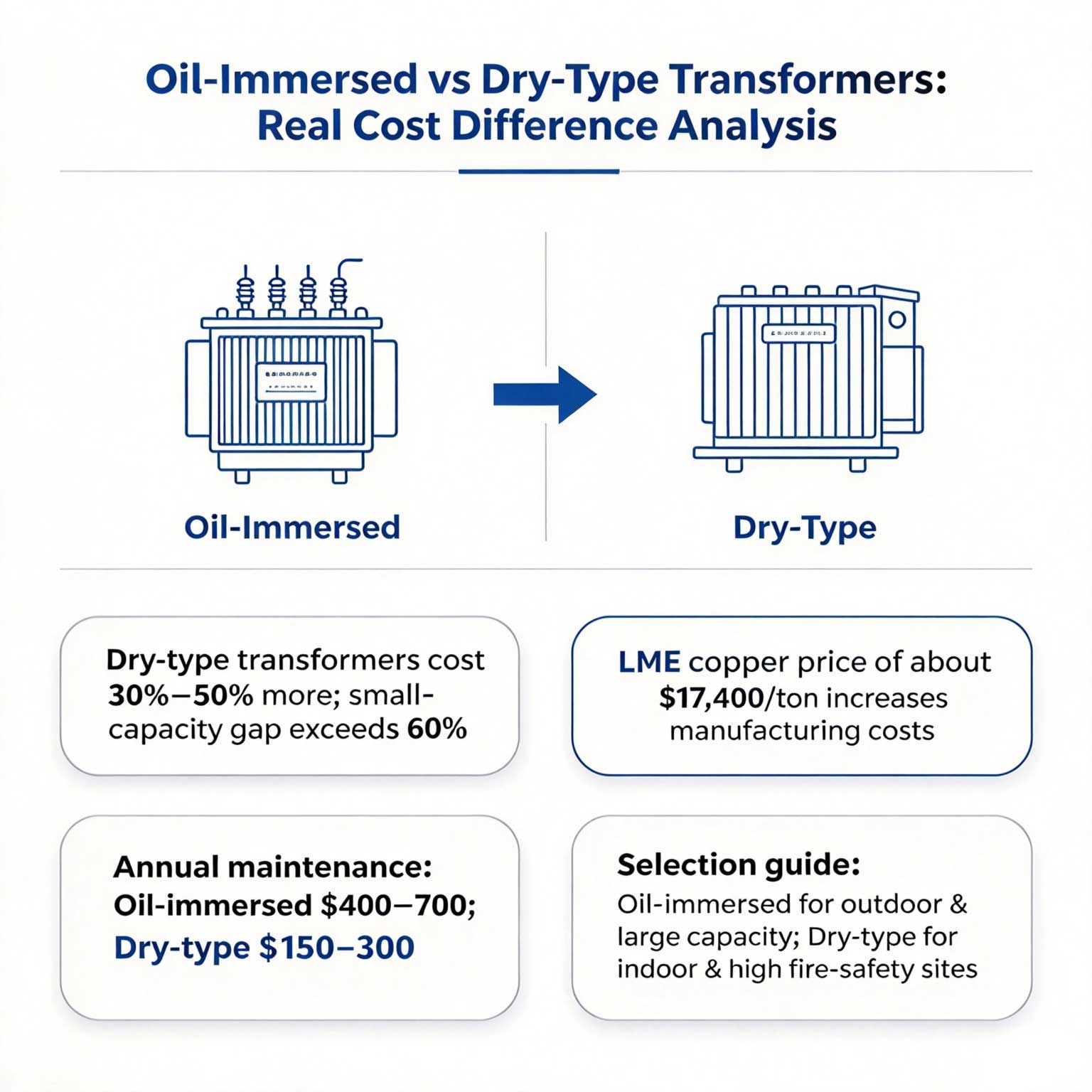
In distribution equipment procurement, the price difference between oil-immersed and dry-type transformers is one of the most pressing questions for decision-makers. The short answer: at the same capacity and with the same winding material, dry-type transformers typically cost 30% to 50% more than oil-immersed units—and at some small-capacity ratings, the gap exceeds 60%. But that’s only the purchase price. The real cost picture is far more complicated.
This article breaks down the price gap between the two transformer types based on current market data and offers guidance on selecting the right type for different scenarios.
Core Price Comparison: The Gap at a Glance
Using copper-wound transformers—the mainstream choice—here is a direct comparison of estimated unit prices (VAT included):
| Capacity (kVA) | Oil-Immersed (S13) | Dry-Type (SCB14) | Premium |
| 100 | $1,900 – $2,450 | $2,600 – $3,000 | ~+35% |
| 200 | $3,000 – $3,400 | $3,700 – $4,100 | ~+22% |
| 315 | $3,800 – $4,800 | $4,800 – $5,700 | ~+24% |
| 500 | $5,300 – $6,800 | $6,700 – $7,500 | ~+20% |
| 630 | $6,500 – $7,500 | $8,200 – $9,500 | ~+25% |
| 800 | $7,800 – $8,900 | $10,200 – $11,300 | ~+32% |
| 1000 | $8,000 – $9,400 | $12,100 – $13,200 | ~+51% |
| 1250 | $9,800 – $11,100 | $13,600 – $16,300 | ~+39% |
| 1600 | $12,100 – $13,600 | $17,100 – $19,000 | ~+41% |
As the table shows, the absolute price gap grows significantly with capacity. At the 1000 kVA level, a dry-type transformer costs nearly 1.5 times as much as an oil-immersed unit. In export markets, dry-type transformers carry a premium of 30% to 60% over oil-immersed equivalents, with the widest spreads occurring at smaller ratings.
Why the Price Gap Exists
Material cost is the primary factor. Dry-type transformers use epoxy resin cast insulation, which requires substantial copper windings to maintain heat dissipation and insulation performance. With copper prices remaining elevated—currently around $17,400 per ton on the LME—this directly drives up dry-type manufacturing costs. Oil-immersed transformers use mineral oil as both insulation and cooling medium, achieving higher heat dissipation efficiency with less copper at equivalent capacity.
Manufacturing process also plays a role. Epoxy resin vacuum casting demands sophisticated equipment and tight process control, and dry-type production cycles are typically slower than oil-immersed, indirectly raising unit costs.
Efficiency-grade premiums apply to both. The S13 oil-immersed and SCB14 dry-type models represent relatively high-efficiency tiers. Moving to Tier 1 efficiency (such as S22 or SCB18) adds roughly 15%–25% to either type.
Purchase Price ≠ Total Cost: The Hidden Expenses
If you look only at the equipment quote, oil-immersed appears more economical. But in real project decisions, the following factors can reverse that conclusion:
Civil works and fire protection costs. If an oil-immersed transformer is installed indoors or within a building, an accident oil pit and fire barriers are mandatory, adding tens of thousands to hundreds of thousands of dollars in civil works. Dry-type transformers are oil-free and contain no combustible materials, so these requirements typically don’t apply. For indoor distribution scenarios below 630 kVA, the total installed cost of dry-type transformers can actually end up lower.
Maintenance cost differences. Oil-immersed transformers require periodic oil sampling, filtration, and eventual replacement. Industry data suggests annual maintenance for oil-immersed units runs roughly $400–$700, while dry-type maintenance is minimal—around $150–$300 per year. Over a 20-year service life, oil-immersed maintenance and repair costs typically range from $8,000 to $25,000, including routine inspections ($4,000–$10,000), DGA oil analysis ($1,200–$4,000), oil filtration or replacement ($1,200–$5,000), and bushing/seal replacement ($800–$2,000).
Losses and electricity costs. For a 1250 kVA unit at 75% load, oil-immersed annual energy losses cost roughly $8,500 versus $9,300 for dry-type. A 20-year total cost of ownership (TCO) calculation shows oil-immersed at approximately $250,000 and dry-type at approximately $270,000—the dry-type purchase premium is partially offset by lower maintenance costs, but oil-immersed retains an overall economic advantage.
Selection Guidance: Look at the Scenario, Not Just the Price
Choose oil-immersed when: the installation is outdoors or in a standalone distribution room; the application involves large-capacity industrial distribution (above 630 kVA); budget sensitivity is high and footprint constraints are minimal. Oil-immersed units also offer advantages in overload capability (up to 140%) and heat dissipation, making them suitable for industrial environments with fluctuating loads.
Choose dry-type when: the installation is indoors (commercial buildings, hospitals, data centers); fire safety requirements are stringent; space is limited (underground substations). Dry-type transformers carry no oil-leak risk, offer good flame resistance, and typically produce less noise (customizable to below 55 dB).
Middle-ground options: If budget is tight but indoor installation is required, consider a small-capacity oil-immersed unit with a dedicated fire-rated enclosure, or an aluminum-wound dry-type transformer (15%–20% cheaper, though with slightly higher losses).
Conclusion
The price gap between oil-immersed and dry-type transformers is real, typically falling in the 30%–50% range. But truly professional procurement decisions must look beyond the equipment quote and factor in civil works, fire protection, maintenance, losses, and project lifespan. Buying cheap and running cheap are two different things. Selecting the right type is worth more than shaving a few percentage points off the discount.
WeChat
Scan the QR Code with wechat