 Jiangsu Shendian Electric Co., Ltd.
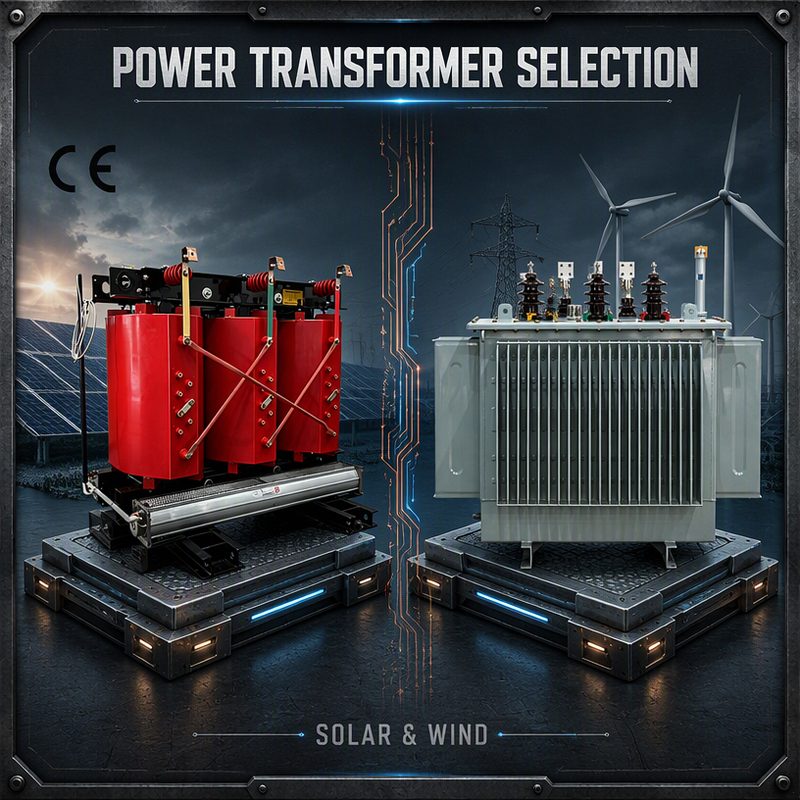
Ask three engineers which transformer is “best” for a renewable project, and you will get three different answers. There is no single winner. The right unit depends on the generation technology, the plant layout, the grid connection, and the site itself. A transformer specced for a wind farm will underperform — or fail early — if you drop it into a solar plant. Here is a practical breakdown of the main options, based on the IEC 60076 standards and published industry data.
Dry-Type vs. Liquid-Immersed
Start with insulation and cooling, because everything else follows. Dry-type transformers cool with air and insulate with epoxy resin; liquid-immersed units use mineral oil or synthetic ester. Oil simply does the job better outdoors: it dissipates heat faster, tolerates overloads, and costs less per kVA. That is why it dominates utility-scale onshore solar and wind. Dry-type wins where fire risk or oil containment is a problem — indoors, offshore, or on space-tight sites. The trade-off is price: expect to pay 40–80% more for the same kVA rating.
Wind Farm Transformers
Wind is hard on transformers. Loads swing with every gust, and the unit thermally cycles again and again over a 25-year life. IEC/IEEE 60076-16:2018 was written for exactly this duty. It covers wind turbine transformers from 100 kVA to 10 MVA and up to 72.5 kV, including cooling correction and testing for harsh electrical environments.
Onshore, the standard layout is one transformer per turbine — roughly 6.9 MVA for a 6.25 MW machine, stepping up from 0.69/0.96 kV to 10 or 33 kV. Liquid-immersed is the norm here. Offshore flips the logic: cast-resin dry-type is preferred, because a single oil leak into the marine environment is one too many, and dry-type needs no fire suppression system. Offshore units should carry Class H insulation, at least IP54 protection, and proper anti-corrosion coatings.
Solar Farm Transformers
Solar is gentler on the winding: output stays steady while the sun shines, so thermal cycling is milder than in wind. The real enemy is harmonics from the inverters. Two fixes matter. First, specify a D,yn11 vector group — it attenuates third-harmonic currents by about 92% compared with a Yyn0 connection. Second, check the K-factor: K=10 is typical, K=13 for high-harmonic sites. Size the transformer 10–20% above total inverter output. For plants above 5 MW, a 10 kV or 35 kV compact substation is usually the cleanest solution. Fault ride-through rules are less defined for solar than for wind, which keeps the design simpler. For utility-scale plants, liquid-immersed remains the standard choice.
Standards and Research
The standards map is still taking shape. IEC 60076-1 covers general requirements; IEC 60076-11 covers dry-type units; IEC/IEEE 60076-16 governs wind turbine transformers. IEC 60076-17 — aimed at PV, battery storage, EV, and hydrogen applications — is still in development. Until it is published, IEEE C57.159 fills the gap for distributed PV. Academic work has documented thermal aging under cyclic wind loads and harmonic resonance in large PV plants. Collector transformers remain the least standardized corner of the market: many use wye-wye-buried delta windings, neutral grounding reactors, and on-load tap changers.
Table 1: Comparison of Transformer Technologies for Renewable Energy
| Parameter | Cast Resin Dry-Type | VPI Dry-Type | Liquid-Immersed |
| Insulation/cooling | Epoxy resin | Vacuum impregnated | Oil or ester |
| Typical voltage | Up to 35 kV | Up to 35 kV | Up to 765 kV |
| Fire risk | Very low | Low | High with mineral oil |
| Indoor use | Standard | Standard | Restricted by code |
| Offshore suitability | Preferred | Suitable | Requires containment |
| Overload capacity | High short-term | Moderate | High |
| Efficiency at full load | 98.0-99.2% | 98.0-99.2% | 98.5-99.7% |
| Cost vs. oil | 40-80% higher | 40-80% higher | Baseline |
| Maintenance | Minimal | Low | Oil testing/leak checks |
| Best renewable use | Offshore wind, indoor solar | Commercial solar | Utility solar, onshore wind |
Table 2: Typical Transformer Configurations for Renewable Energy Projects
| Project Type | Generation Voltage | Collection Voltage | Step-Up Rating | Substation Rating | Preferred Type |
| Onshore wind (20-200 MW) | 0.69/0.96 kV | 10/33 kV | 1.5-10 MVA per turbine | 20-100 MVA | Liquid-immersed |
| Offshore wind | 0.69/0.96 kV | 33/66 kV | 5-15 MVA per turbine | 100-400 MVA | Cast resin dry-type |
| Utility solar (10-200 MWp) | 0.4-0.6 kV | 33 kV | 1-5 MVA per block | 20-100 MVA | Liquid-immersed |
| Commercial solar (0.5-5 MW) | 0.4 kV | 10/11 kV | 0.5-5 MVA | N/A | VPI or cast resin |
| Battery storage (10-100 MW) | 0.4 kV | 10-33 kV | 1-5 MVA bidirectional | 20-100 MVA | Liquid-immersed |
| Hybrid wind+solar+storage | Mixed | 33 kV | Multi-winding | 50-200 MVA | Liquid-immersed |
The Bottom Line
The right transformer is the one that matches your duty profile and environment — nothing more exotic than that. Liquid-immersed is the workhorse for utility-scale onshore solar and wind: lowest cost per kVA, best thermal performance, best overload tolerance. Cast-resin dry-type earns its premium offshore and indoors, where fire safety and oil containment rule. VPI units suit commercial solar. Whatever you buy, verify it against IEC 60076-16 for wind and IEEE C57.159 for distributed PV — and against IEC 60076-17 once it lands. Get the specification right the first time. These machines are built to run 25 to 40 years, and there is no cheap fix for the wrong one.
WeChat
Scan the QR Code with wechat